Pasture to Patio: The Comal County Landmarks We're Losing — and the Ones Rising in Their Place
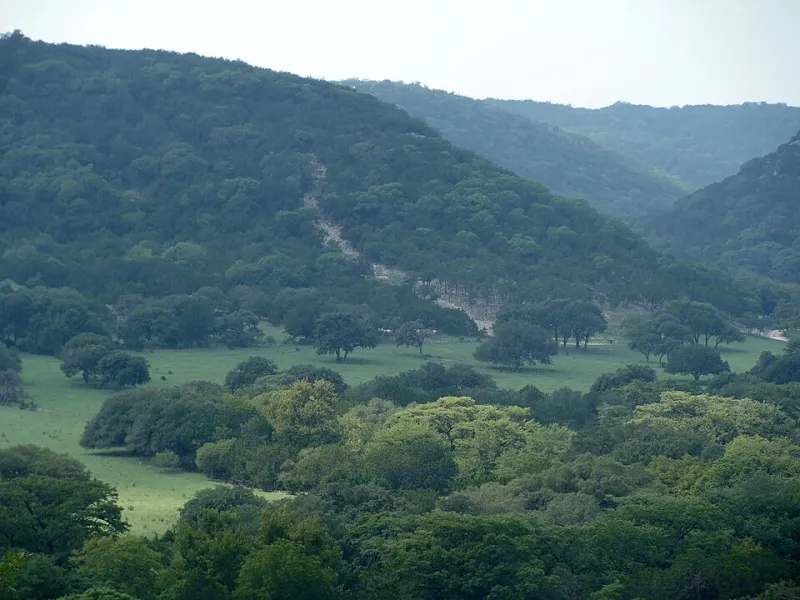
Photo: Zereshk, CC BY-SA 3.0, via Wikimedia Commons
Drive FM 306 out toward Canyon Lake on a Saturday morning and you can watch Comal County change in real time. On one side of the road: a hay field, still cut, still working. On the other: a sign promising 240 new homes, complete with a render of a family that looks suspiciously happy about the commute.
If you've lived here more than a decade, you've probably had the conversation. The one at the gas station in Sattler, or over kolaches in New Braunfels, that starts with "remember when" and ends with a head shake. The county added roughly 30,000 residents between 2010 and 2020, and the growth hasn't exactly hit the brakes since. Change this fast leaves marks. Some of them are worth mourning. Some of them, honestly, are worth celebrating. Here's a look at both.
The Hay Fields That Became cul-de-sacs
Ask any ranching family in the county what's changed most and the answer is rarely a building. It's land. Family acreage that survived three or four generations keeps getting sold — not because anyone wants to let go, but because property taxes on land near a growing metro make "just hold onto it" harder every year. A pasture that supported cattle in the '90s can be worth more as a subdivision site than the cattle could earn in a lifetime.
Longtime residents in the Bulverde and Garden Ridge corridors describe watching fence lines vanish. The old photos tell the story plainly: the same stretch of road, twenty years apart, one full of live oaks and open sky, the other full of rooftops. There's grief in that. There's also, as one Spring Branch rancher put it to us, "the math nobody wants to do out loud."
The Landmarks That Didn't Make It
Every community keeps a mental list of places that closed too soon. In Comal County, recent years have taken a handful of institutions — a beloved dance hall here, a roadside barbecue joint there, a few of the old-school feed stores that doubled as unofficial community centers. Some closures came down to economics. Some came down to the land itself becoming too valuable to keep a business on. When a property owner gets an offer from a developer that's ten times what the business earns in a year, sentiment only carries you so far.
The pattern isn't unique to here — it's the story of every Hill Country county within commuting distance of a big city. What matters is what happens next.
What's Taking Root
Here's the part the nostalgia gets wrong: Comal County isn't losing its identity. It's renegotiating it.
The new arrivals are bringing their own version of what made this place appealing in the first place. Downtown New Braunfels keeps adding local restaurants and shops that lean into the town's German and river-town heritage rather than erasing it. Gruene Historic District remains the model everyone else is chasing — proof that preservation and profitability can share a zip code. Farmers markets, craft breweries, and live music venues are filling the gaps left by the old gathering spots, just in different packaging.
Even the subdivisions are adapting, slowly. Newer developments around Canyon Lake and along the 46 corridor are setting aside green space and trail connections, a quiet acknowledgment that people moved here for the trees, not the concrete.
Keeping the Good Parts
The residents we talked to — the ones who've watched four decades of change — mostly land in the same place. You can't freeze a county in amber, and nobody actually wants to. What you can do is show up for the things worth keeping: the dance halls still holding weekend two-steps, the family-owned restaurants hanging on, the land trusts and conservation easements quietly protecting ranchland from the bulldozer.
Comal County in 2026 won't look like the place in your old photos. It never does, anywhere. But the rivers still run, the smoke still rises from the pits, and the new neighbors are learning the same lesson every generation of locals has learned: this place is worth knowing deeply. The landmarks change. The reason people love it doesn't.