Door Splits, Dance Halls, and a Trailer Full of Amps: One Saturday With a Comal County Working Band
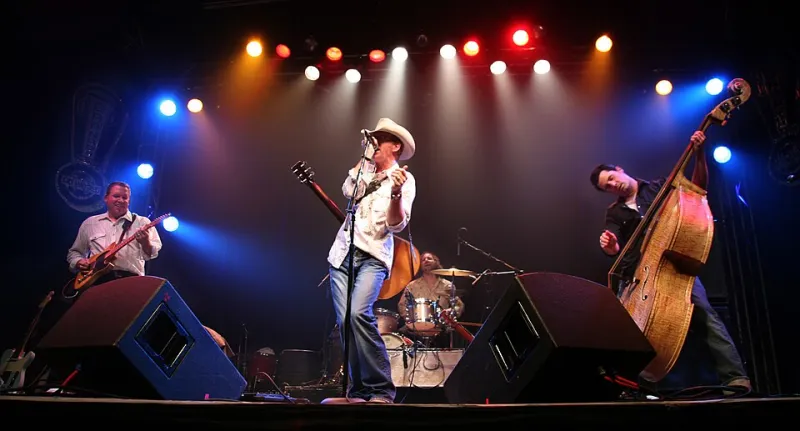
Photo: Sparkybones, CC BY-SA 3.0, via Wikimedia Commons
The trailer is packed by 4:30 p.m., which is a minor miracle. Drums, a bass rig, two guitars, a pedal steel, and a soundboard that has opinions about humidity — all of it wedged in with bungee cords that have been bungee cords since roughly 2016.
By 5:15, the five members of the band are rolling north out of New Braunfels toward a dance hall outside Gruene, where they'll set up, soundcheck, play three sets, and hopefully walk out with a few hundred bucks each. Nobody in the group is quitting a day job over this. Everybody in the group would tell you they're exactly where they want to be on a Saturday night.
This is the garage band economy of Comal County — the network of weekend players, hall owners, and booking folks who keep live music humming in venues that don't have tour buses parked out back.
The Circuit Nobody Advertises
Ask around long enough and you'll hear the same names: the halls near Gruene, the beer joints along the river corridors, the VFW and community halls that have hosted dances since somebody's grandfather was courting somebody's grandmother. These rooms operate on a rhythm that has nothing to do with Spotify charts and everything to do with the calendar.
Wurstfest weekend? Forget booking anything else. Peak river season, mid-June? The halls fill up with sunburned tourists who'll dance to anything. The Saturday after Easter, when every cousin in the county is in town? Gold.
Local musicians learn this calendar the way farmers learn frost dates. It dictates when they can command a decent guarantee and when they're playing for tips and free Shiner.
Loading In, Cash Splitting, and the Real Math
The economics of a hall gig are refreshingly simple and brutally transparent. Most of these rooms operate on a door split — the band and the venue agree on a percentage before the night starts, commonly somewhere in the neighborhood of 60/40 to 80/20 depending on the draw and the overhead.
Tonight's arrangement: the band keeps 70 percent of the cover at the door, the hall keeps 30 and makes its real money on beer. If 150 folks pay $10 each, that's $1,050 for the band. Split five ways after the trailer's gas is covered, each player heads home with a little over $200. A good night. A bad night — 40 people, half of them sitting down — and everybody's looking at $60 and a free burger.
That's why the booking game matters so much. A band that can pull a consistent crowd doesn't just earn more; it earns leverage. Hall owners keep mental ledgers of which acts bring dancers and which bring sitters, and the dance floor crowd drinks more. Everybody in town knows it, even if nobody says it out loud.
Three Genres, One Dance Floor
Here's what makes Comal County's scene different from, say, Austin's: the audiences don't divide neatly by genre. A single Saturday crowd in this county can contain a couple celebrating their fortieth anniversary who want George Strait covers, a bachelorette party that wants anything with a fiddle, and an older contingent that lights up the moment the horns kick into a polka.
Smart bands learn to code-switch. Texas country in the second set. A Tejano standard when the right table starts paying attention. A German tune — even a slightly winking one — because this is still a county where the heritage halls never really closed. The best local acts don't treat polka as a novelty; they treat it as part of the set list's DNA, the way it has been here for 150 years.
"You play what the floor wants," the band's frontman says between sets, watching an older couple waltz past the soundboard. "The floor is the boss. Not the booker, not the bar. The floor."
The People Who Hold It Together
The unsung infrastructure of this economy is small and personal. There's the hall owner who texts bands on Monday to fill a cancellation by Friday. The semi-retired booking woman who knows every private event, wedding, and fireman's dance on the calendar six months out. The sound guy who works three rooms a weekend and can fix a feedback loop with his eyes closed.
Nobody in this ecosystem is getting rich. But the money that does circulate — door splits, bar tabs, tip jars, the occasional wedding gig that pays double — stays almost entirely local. It's a genuine micro-economy, one that turns weekend hobbies into paychecks and keeps dance halls solvent enough to host the next generation of garage bands.
Why It Matters
You can measure a community by a lot of things — tax base, school ratings, commute times. Or you can measure it by whether a 19-year-old kid with a pawnshop Telecaster can find a room on a Saturday night that will actually pay him to play.
In Comal County, that room exists. Usually several of them. And the trail of trailers rolling down Farm-to-Market roads every weekend, full of amps and ambition and just enough cash to make it worth the load-in, is one of the quietest reasons this place still feels like itself.
Next time you're two-stepping at a hall near Gruene and the band nails a song you didn't expect them to know, tip the jar. The floor may be the boss — but the floor doesn't pay for guitar strings.