What Comes Out of the Faucet: The Water Math Under Comal County's Boom
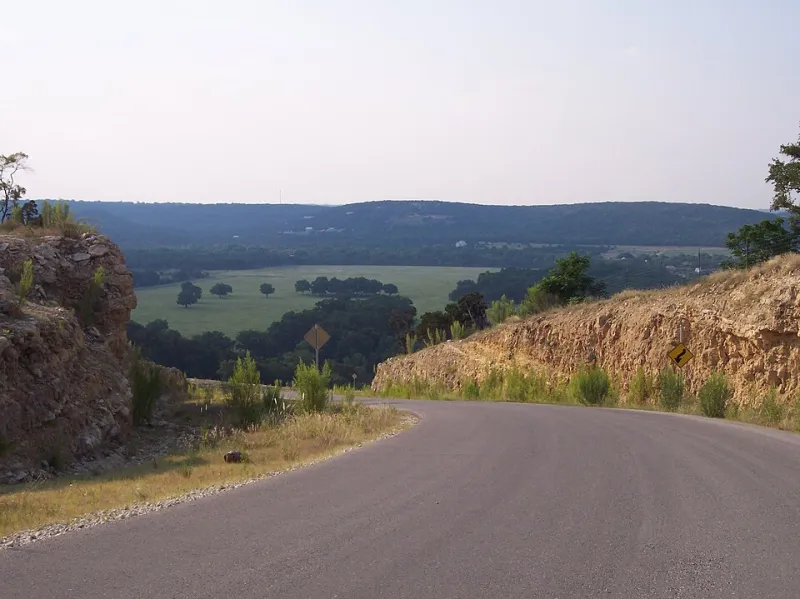
Photo: CMBJ, CC BY-SA 2.5, via Wikimedia Commons
Drive north out of New Braunfels on any given weekday and you'll pass a version of the same scene: a graded field, a construction entrance, a sign promising a hundred and some homes, and a sales office already open. What you won't see is the part that decides whether all of it works. That part is underground, and it is not infinite.
Comal County sits on top of two different water systems that behave in two completely different ways. Understanding that split is the single most useful thing a new resident can learn about this place, and almost nobody explains it before closing day.
Two aquifers, one county
The first is the Edwards Aquifer, the famous one. It's a fast, karst system — basically a plumbing network dissolved through limestone — that recharges quickly from rainfall and moves water underground the way a river moves on the surface. Comal Springs in Landa Park is an Edwards discharge point, and it's one of the largest springs in the state, home to species that exist nowhere else on earth.
The second is the Trinity Aquifer, which underlies most of the county's hills and rural acreage. It's older, deeper, more complicated, and it recharges slowly — think decades, not weeks. Most of the household wells in the western and northern parts of the county pull from the Trinity, and so do a lot of the smaller water systems that serve subdivisions outside city limits.
Here's why the distinction matters: they are governed by different regulators, measured by different models, and they respond to drought on completely different timelines. A homeowner in the city of New Braunfels is having a very different water conversation than a homeowner on five acres outside Bulverde, even though they're twenty minutes apart.
The number everyone watches
For the Edwards side, the metric that drives everything is springflow. When the springs drop below certain thresholds, state regulators impose pumping cuts, and those cuts ripple through municipal water systems and agricultural users alike. It's not a hypothetical. During the drought of record in the 1950s, Comal Springs stopped flowing entirely, and that memory is the reason the regulatory system exists at all.
The Trinity side is less about a single dramatic number and more about trend lines in observation wells — long-running measurements from a network of monitoring points that show whether the water level is holding, drifting down, or dropping fast in a particular area.
"People want a simple scoreboard," said a hydrologist who models Trinity conditions for a regional river authority. "But groundwater isn't a scoreboard. It's a budget, and in some parts of this county we've been writing checks against savings."
What growth actually changes
The honest answer is that it depends on where the growth lands. New subdivisions inside a city with surface water supply are a different proposition from subdivisions on private wells. New Braunfels Utilities delivers a mix that includes surface water from Canyon Lake, which means its customers are not solely dependent on what's under their feet. Development out past the city limits often is.
There's also the land-use piece, which is easy to overlook. Rain that falls on open ranchland soaks in and eventually recharges. Rain that falls on a subdivision goes into detention ponds, streets, and storm drains. Recharge doesn't stop, but it slows and concentrates. Multiply that across a few thousand acres and you've changed how the system refills, not just how much gets pulled out.
"Nobody's against houses," said a rancher west of Bulverde who has logged his well readings since the late 1990s. "But when the wells around you start drawing down and the creek behind you runs shorter every year, you start asking who's keeping count. And the answer for a long time was nobody in particular."
That gap is why the county has a groundwater conservation district tasked with permitting and tracking non-Edwards wells, and why its board meetings have gotten a lot more crowded in the last handful of years. Permitting rules, spacing requirements, and drought curtailment are all being argued over in rooms most residents have never walked into.
The questions a buyer should actually ask
If you're looking at property outside a city water system, ask these before you fall in love with the view.
- Which aquifer does this well draw from, and how deep is it? A shallow Edwards-influenced well and a deep Trinity well are entirely different risks.
- Is there a well log or pump test? Ask to see it. A pump test tells you what the well produces under load, not just that it runs.
- Has the water level in nearby monitoring wells been trending down? The data is public. Ask the conservation district.
- What are the drought restrictions, and who enforces them? Rules differ block by block.
- What happens to my water bill if the system I'm on gets a curtailment order? Some systems pass costs through; some absorb them; some can't.
- Is this lot in a recharge zone with extra development limits? Good to know before you design the shop building.
None of these questions has a tidy answer, and any seller who tells you otherwise is selling more than a house.
The part nobody wants to fund
Monitoring, modeling, and enforcement cost money, and the entities doing the work operate on budgets that are small relative to the value of the resource they're watching. That's an old Texas story, and it isn't unique to Comal County.
The optimistic read is that awareness has genuinely shifted. Ten years ago, aquifer talk was a niche concern for farmers and anglers. Today it comes up at city council meetings, in homeowners association forums, and at kitchen tables where a family is deciding whether to buy acreage with a well or a lot with a meter.
The less optimistic read is that awareness arrives faster than policy does. Growth in this county is not waiting on a hydrology study to finish.
Either way, the water under Comal County is not background scenery. It's the thing that keeps the springs running, the river cool, and the faucets working. Asking who's keeping count is not a hostile question. Around here, it's the most local question there is.